


Head of Programme Michaela John visits Singapore to learn more about mainstreaming genomics

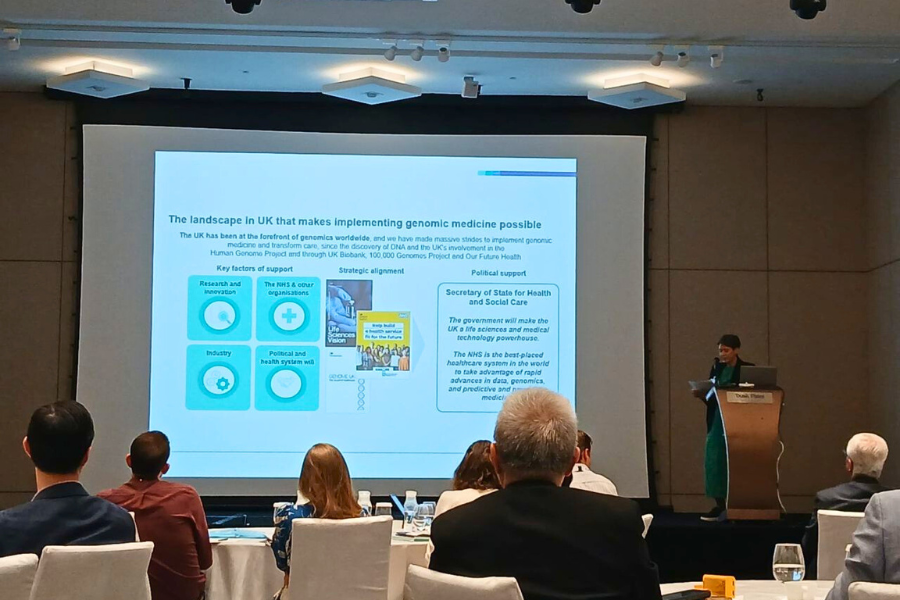
Last month, our Head of Programme Michaela John travelled to Singapore to attend a two-day workshop on ‘Mainstreaming Genomics for Precision Population Health’, alongside colleagues from Welsh Government, Public Health Wales, All Wales Medical Genomics Service and Cardiff University.
Whilst there, Michaela gave a presentation on the ‘Genomics Infrastructure Across The UK’ and engaged in discussions on how the UK and Singapore can work together to share learning and development opportunities.
Myself and a number of other colleagues from Wales were invited to attend a workshop jointly hosted by the Singapore College of Clinician Scientists and the UK Academy of Medical Sciences. Attendees included researchers, clinicians, policymakers, regulators, patients and industry, from the UK and Singapore. The purpose of the workshop was to explore current challenges and barriers to the implementation of genomic medicine on a population level, provide the opportunity for networking between attendees and a platform to share experiences and lessons learned. It was anticipated that the workshop would identify a list of research priorities and policy next steps to address the identified challenges and opportunities to work together.
We were welcomed by the organisers who posed two questions – how can Singapore and the UK provide genomic testing at the population level without exacerbating health inequalities? And what are the ethical considerations and implications of genomic testing on a population level?
The workshop sessions involved a presentation from the UK and Singapore followed by breakout groups each with a theme and specific questions; these included genomic infrastructure (biobanks, testing centres and data), policy, adoption and implementation (disease genomics, cascade testing and pharmacogenomics), and governance and regulation (workforce, medicine regulation and technology assessments). But by far the most powerful element was the embedding of Patient and Public Involvement (PPI) in the workshop; the first main session involved a presentation given by the patient representatives highlighting their ambitions and expectations. Having their perspective and expertise throughout the workshop was invaluable in ensuring the focus on our patients across the discussions.
A report will be published which will synthesise the key discussion points from the workshop, capturing identified barriers, priorities, and next steps, with the aim of informing policy and research decisions.